From Westminster to Octopus HQ: Energy Storage’s Momentum Builds
From the ancient halls of The House of Lords to the neon pink modernity of Octopus HQ. Guy Clark reflects on the Energy Storage Association’s second networking event of 2026. It is barely four months since Baroness Luciana Berger, the Chair of the Energy Storage Association, welcomed around fifty ESA members to our first networking event of the year in a packed room at the House of Lords. When she took the stage at Octopus HQ’s event space on Thursday, she welcomed nearly one hundred. That momentum was a major theme of the talks that followed.
Baroness Berger began by reiterating the government’s commitment to bringing down bills for good through more homegrown clean power. She highlighted the momentum achieved on this journey to date, with GBE Energy now fitting solar panels or a battery on public sector properties every two days, and with the progress made on the LDES cap and floor scheme over the last two years. She also paid tribute to the exciting partnership between two ESA members, with Keele University agreeing to install a demonstrator new Zinc LDES battery manufactured by Offgrid Energy Labs – the first battery project of its kind to be made in the UK. She also recognised the challenges we are facing. We are wasting too much clean energy: 10TWh of wind power in 2025, enough to power London for a year. We are heavily dependent on international products: three quarters of lithium-ion battery supply chains flow through China. The LDES cap and floor, for all its strengths is not doing enough to support the development of new technologies and new supply chains here in the UK. Holistic industrial policy, that recognises the integral role of storage in the energy system and in the wider economy will be needed to address these challenges, and our next speaker only confirmed that.
We were lucky to have Bill Esterson MP, Chair of The Energy Security and Net Zero Committee, back with us again. He once again demonstrated that the contributions and concerns of the energy storage sector are being recognised at the highest level of government. Fundamentally, he acknowledged that the rapid momentum of technological progress is far outpacing regulation – something anyone engaging in the PAS63100 review will strongly agree with. He recognised that many policy decisions seem to have been made with far too great a focus on upfront cost, and not enough recognition of long-term benefits – within the energy system and the wider economy. He also shared that he is putting pressure on DESNZ to get the Warm Homes Plan loans and grants delivered as quickly as possible. As he said, the more people can feel the benefits of this energy transition, the more people will understand that those benefits are economic as much as environmental. Finally, he ended by emphasising a message this sector has long championed: “flexibility is the answer to the affordability issue.” a theme elaborated on by our next speaker.
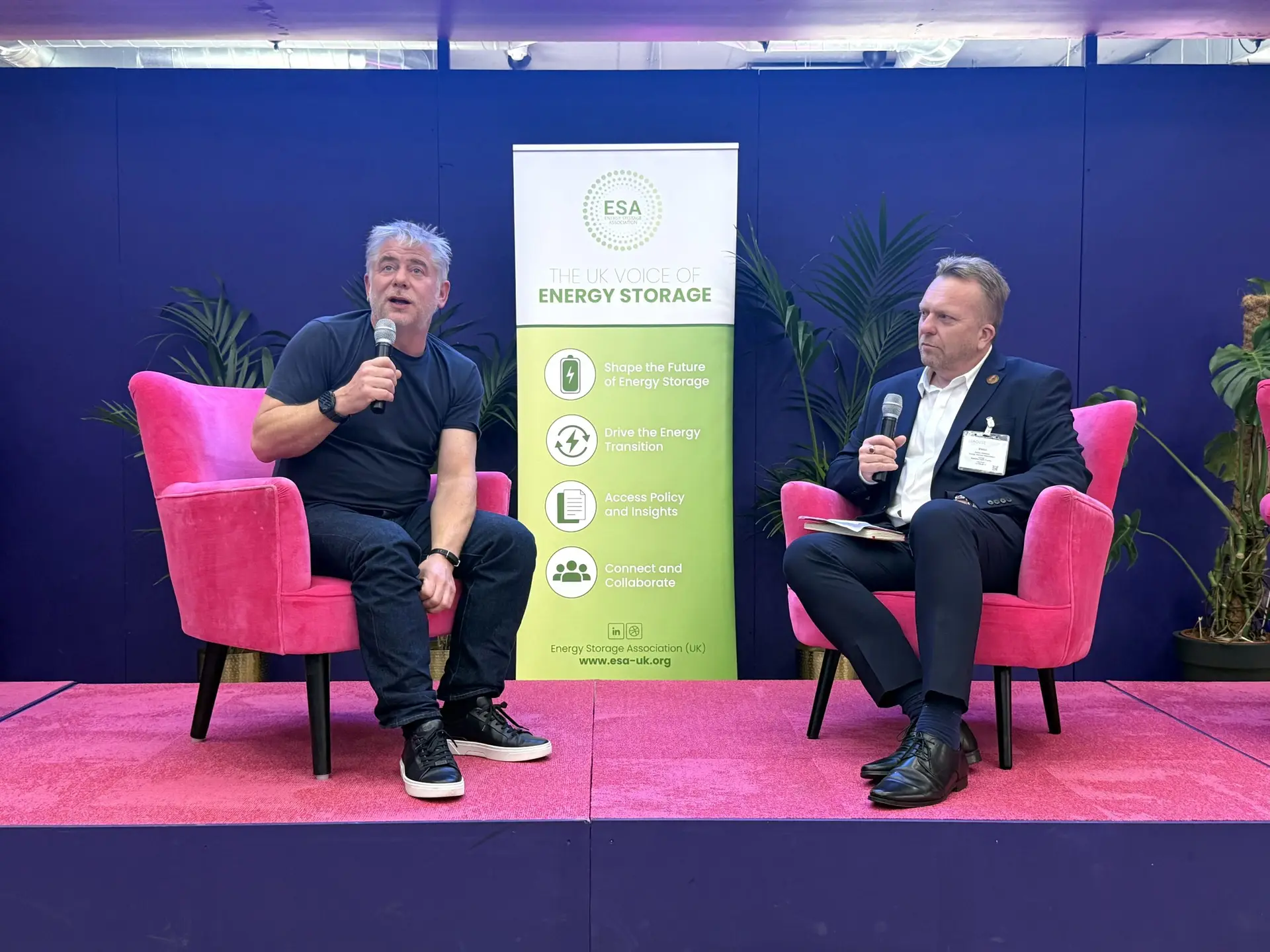
Octopus CEO Greg Jackson is one of the most prominent champions of system flexibility in the country. Over a wide-ranging interview with ESA CEO Jason Howlett, the discussion covered everything from Scottish wind farms to Chinese electric truckers, but a few key points stood out. Jackson argued we are building a grid to accommodate huge surges in electricity demand, and in doing so, making electricity so expensive that demand may never appear. The 20th century approach – a grid that can carry any amount of electricity to any part of GB – must give way to a recognition that electricity in a renewable world is a locational commodity. That, he suggested, is how we get bills down and flexibility and storage are a key part of that. If those two elements were properly modelled, Jackson continued, two thirds of planned grid projects would be cancelled – translating to a significant reduction in bills.
The CEGB of the 1960s used to never plan network build more than five to seven years in advance, because the pace of technological change meant those plans could quickly become outdated or redundant. Transmission operators today are making plans fifteen years in advance at a time when technological change is orders of magnitude greater than in the 1960s. The UK is spending £150bn – and Europe is spending €1.4Tn – of billpayers’ money on grid projects we may not need thanks to advances like vehicle-to-grid EV charging and the plunging costs of battery and solar. So how can industry and policymakers come together to make change that? First of all, Jackson acknowledged the progress government has made bringing the spark gap – the gap in price between electricity and gas – down from 4.4 to 3.3 via its removal of VAT and certain policy levies.
That’s a meaningful achievement that will spur electrification. However, he then threw down the gauntlet to private and public sectors. Industry needs to provide the small, demonstrator projects that can give firm evidence on how storage buildout can reduce network costs. On the other hand, policymakers need to stop “modelling for perfection” before taking the first step. If there are solutions that could make a practical difference to bill reductions and decarbonisation they need to be brought forward before they are perfectly designed or able to be applied across the whole country. Aligning national policy with the latest industry innovation is just what the ESA was founded to do, and we look forward to continuing that mission.
Our final speaker, ESA Operations and Strategy Director, John Southern, ended proceedings by outlining just what the Association and its members had achieved on that mission so far. Since we last gathered in the House of Lords, we have secured an urgent review of PAS63100 that begins this month and will conclude in Q1 2027, with ESA representation on the BSI technical committees. We launched the Battery Secure insurance-backed guarantee, ensuring consumers are protected in the event of manufacturers going bust. We were invited by DESNZ to submit a tender to run the safety study for plug-in batteries, and we will be on the review panel for the study even in the event we aren’t conducting it. We published policy proposals for a Salary Sacrifice Scheme for Batteries. We also secured changes to the Home Energy Model to fully incorporate battery and inverter data, as well as the opportunity for members to register their products for free before HEM launches. None of this could have happened without the brilliant contributions – of evidence, expertise and time – by the membership. Southern ended with a call to everyone in the room: keep those contributions coming and we will keep building this momentum, keep building the distributed, flexible energy system this country so badly needs.
19th October 2026